Vision-Language-Action Models (VLA): The Cognitive Layer
We have a body (ROS 2), a world (Gazebo), and a brain that can navigate (Nav2). Now we need a Mind—something that understands intent.
The Semantic Gap
- Traditional Robotics: Knows "Move to x=5, y=10". Does NOT know "Go to the kitchen."
- LLMs (Large Language Models): Know what a "kitchen" is, and that "food" is usually found there.
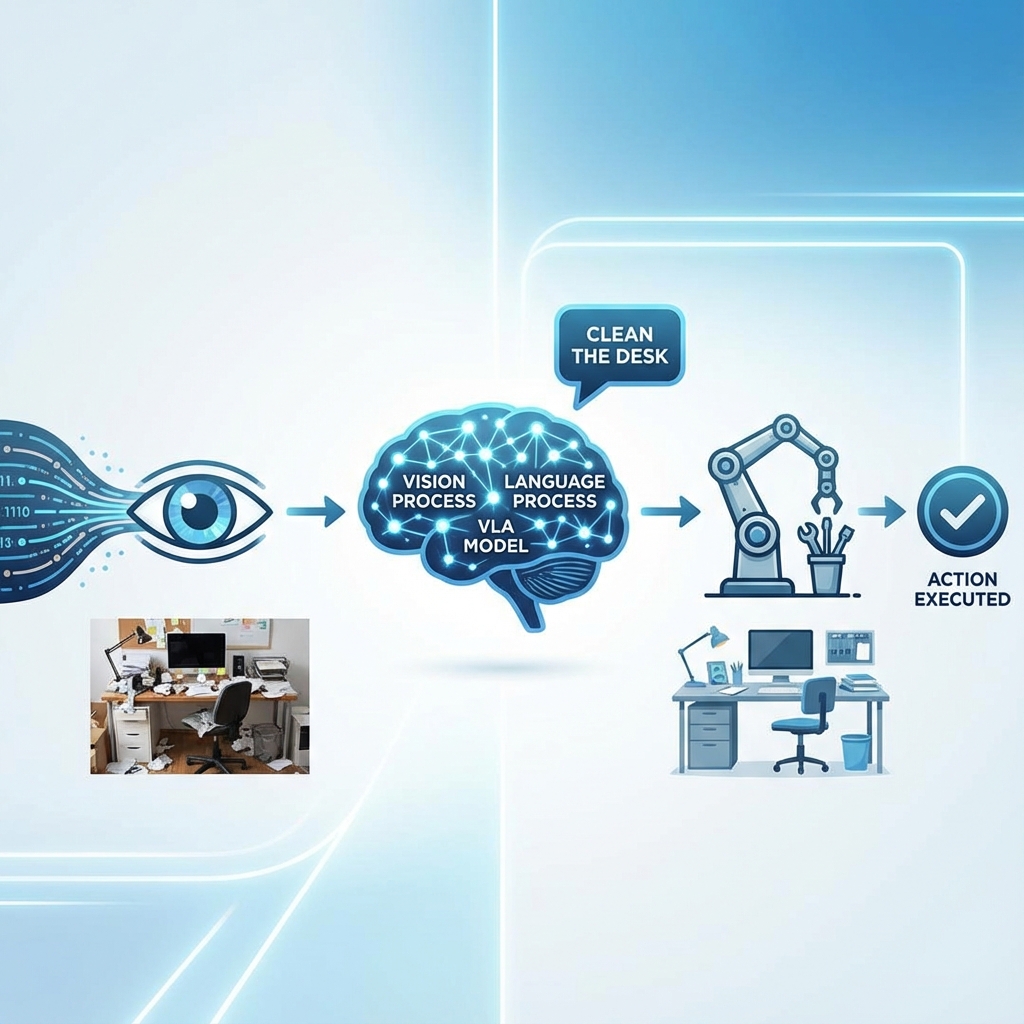
Bridging this gap is the goal of VLA.
sequenceDiagram
    User->>+Whisper: "Find me a snack"
    Whisper-->>-LLM: Text: "Find me a snack"
    LLM->>+Scene: What objects do I see?
    Scene-->>-LLM: [Apple, Book, Cup]
    LLM->>LLM: Reasoning: Snack = Apple
    LLM->>+Nav2: navigate_to("Apple")
    Nav2-->>-LLM: Arrived
    LLM->>Arm: pick_up("Apple")
Voice as an Interface
We start with speech. OpenAI Whisper is the state-of-the-art for Speech-to-Text (ASR). It runs fast on GPUs.
import whisper
model = whisper.load_model("base")
result = model.transcribe("audio.mp3")
print(result["text"]) # "Go to the kitchen and find me a snack."
From Text to ROS Actions
How do we turn "Find me a snack" into cmd_vel?
1. The Prompt Engineering Approach
We can give an LLM (like GPT-4o or Llama 3) a list of available ROS Actions as tools.
System Prompt:
You are a robot assistant. You have the following tools:
navigate_to(location_name)scan_for_objects()pick_up(object_name)The user says: "Find me a snack." Plan a sequence of actions.
LLM Output:
navigate_to("kitchen")scan_for_objects()pick_up("apple")
2. End-to-End VLA Models (RT-2, PaLM-E)
Google's RT-2 (Robotic Transformer) is a model trained on both internet text/images AND robot trajectory data. It outputs direct robot actions (effector tokens) instead of just text.
- Input: Image of a desk + Text "Pick up the extinct animal".
- Output: The robot arm moves to the plastic dinosaur.
This is "Embodied Reasoning". The model understands "extinct animal" = "dinosaur" and connects it to the visual pixels of the dinosaur toy.
Implementation Details
We will build a simple "Cognitive Node" in Python.
- Listener: Subscribes to
/voice_command. - Thinker: Sends text to an LLM API (OpenAI or Local Llama via Ollama).
- Executor: Parses the LLM's JSON response and calls ROS 2 Action Servers.
# executor_node.py
def execute_plan(plan):
    for step in plan:
        if step['action'] == 'navigate':
            nav_client.send_goal(step['target'])
        elif step['action'] == 'pick':
            manipulation_client.send_goal(step['object'])
Safety and Hallucination
LLMs hallucinate. You do NOT want a robot to hallucinate a command like "Jump out the window."
- Guardrails: Code layers that sanity-check the LLM's output.
- Grounding: Verifying that the object "apple" actually exists in the visual scene before trying to grab it.
In the capstone, we will put this all together.