NVIDIA Isaac Sim: The AI-Robot Brain
The Era of Simulation-First AI
Traditional robotics relied on hand-coded algorithms. Modern AI robotics relies on Deep Learning. To train a deep neural network, you need data—terabytes of it. Getting this data from the real world is slow and expensive.
NVIDIA Isaac Sim is built on Omniverse. It allows us to generate infinite "Synthetic Data" that is photorealistic and physically accurate.
Key Features
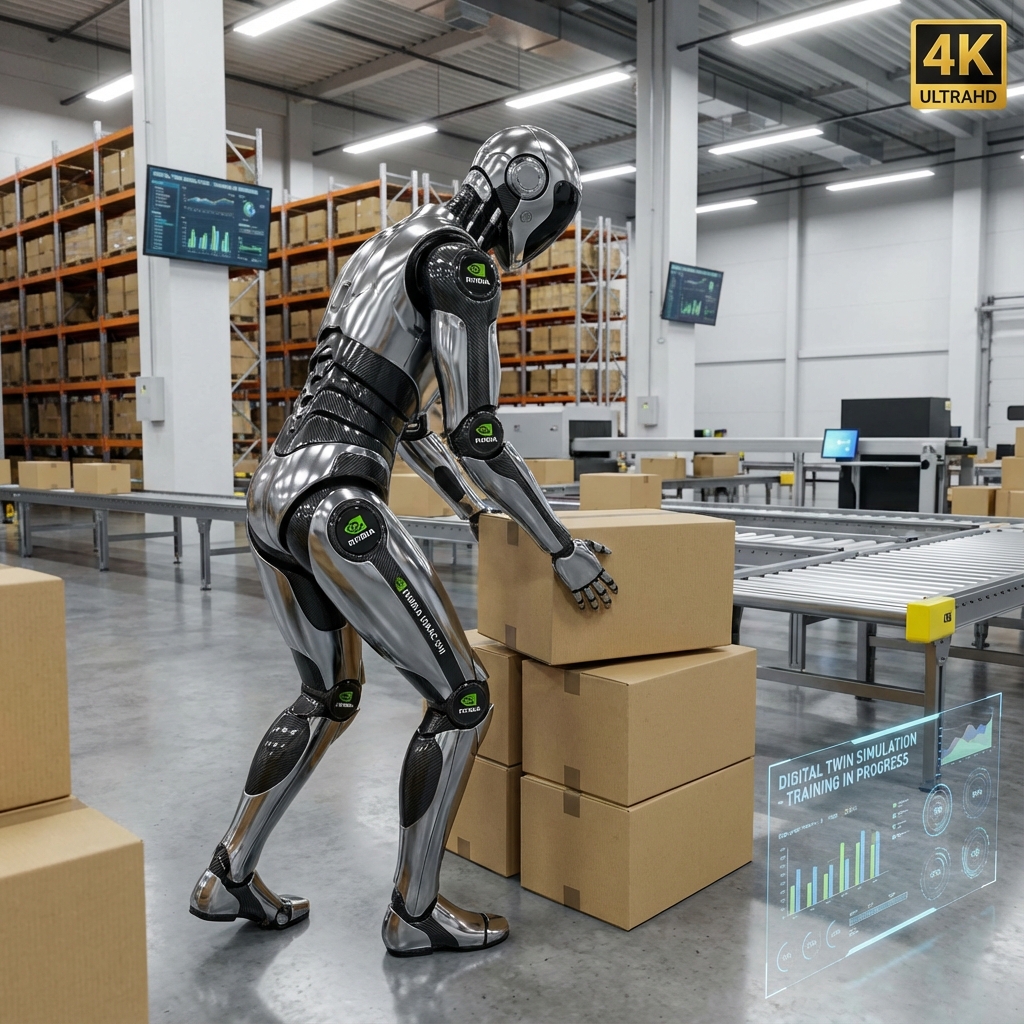
- Photorealism: RTX-enabled ray tracing.
- Domain Randomization: It can automatically change the lighting, floor texture, and object colors every frame. This prevents the AI from "overfitting" to a specific carpet pattern. If the AI learns to see a cup in 10,000 weird lighting conditions, it will recognize a cup in the real world easily.
- GPU Physics: PhysX 5 running on the GPU allows simulating thousands of robots in parallel.
Isaac ROS (The GEMs)
Isaac isn't just a simulator. It's also a suite of GPU-accelerated ROS 2 packages (GEMs).
- Isaac ROS VSLAM: Visual SLAM. Finding the robot's position using cameras.
- Isaac ROS Nvblox: 3D reconstruction. Building a voxel grid of obstacles on the GPU.
- Isaac ROS DNN Inference: Running YOLOv8 or standard object detection models optimized for Jetson.
Setting up Isaac Sim
Isaac Sim requires a powerful GPU (RTX 2070+ recommended).
- Install NVIDIA Omniverse Launcher.
- Download Isaac Sim through the launcher.
- Launch the
ROS 2 Bridgeextension.
The ROS 2 Bridge
This bridge is the magic portal. It maps Omniverse data to ROS 2 topics.
- Omniverse:
/World/Robot/Camera(USD Prim) - Bridge: Maps to
/camera/image_color(ROS Topic)
Training a Policy (Reinforcement Learning)
We can use Isaac Gym (embedded in Isaac Sim) to teach a humanoid to walk.
- Reward Function: +1 for moving forward, -10 for falling, -0.1 for using too much energy.
- Training: We run 4096 robots in parallel on a single GPU.
- Result: In 20 minutes of simulation, the robot collects years of experience and learns a robust walking gait.
Sim-to-Real Transfer
The biggest challenge is Sim-to-Real Gap. If the physics/friction in sim isn't perfect, the policy fails in reality. We close this gap using:
- System Identification: Measuring real friction/mass accurately.
- Domain Randomization: Training on a distribution of physics parameters (e.g., friction = 0.5 ± 0.1).
In the next section, we look at Navigation—how to move without bumping into things.